1. Introduction
In the digitally advanced world of today, cybersecurity is essential, not optional. Cyberattacks pose a continual threat to people, governments, and businesses worldwide. HopeInfotech’s Cybersecurity Online Training is intended to give students the thorough understanding and useful skills they need to succeed in this vital industry, as the demand for qualified cybersecurity experts is growing rapidly.

2. Why Choose Cybersecurity as a Career?
Experts in cybersecurity who can safeguard data, networks, and infrastructures are desperately needed as a result of the global move to digital platforms. The risks are many and always changing, ranging from ransomware attacks to phishing schemes and advanced methods for hacking. Industry research projects that the worldwide cybersecurity sector will grow to $376 billion by 2029, demonstrating the enormous size and need for qualified workers. Enrolling in a top-notch training program, such as Hope Infotech’s, puts you at the vanguard of this rapidly expanding field and gives you access to well-paying positions, stable employment, and chances for international career progression.
3. Overview of Hope Infotech’s Cybersecurity Online Training Program
The online cybersecurity course offered by Hope Infotech is designed for students at all skill levels. This course is highly useful regardless of whether you are freshly graduated, an IT professional seeking to advance your skills, or someone hoping to transition to a fulfilling job in cybersecurity. Important aspects of the 100% online cybersecurity course delivery include: with flexible scheduling, you can learn from anywhere around the world. Hands-on Labs: Use virtual labs and simulations to gain practical experience. Learn from professionals with years of real-world experience thanks to industry-certified instructors. Worldwide Accredited Certification: Obtain a certification that enhances your credibility and resume. Lifetime Access to Resources: Lecture recordings, study guides, and video tutorials are all kept accessible for future use.
4. Types of Cybersecurity Threats You Need to Know
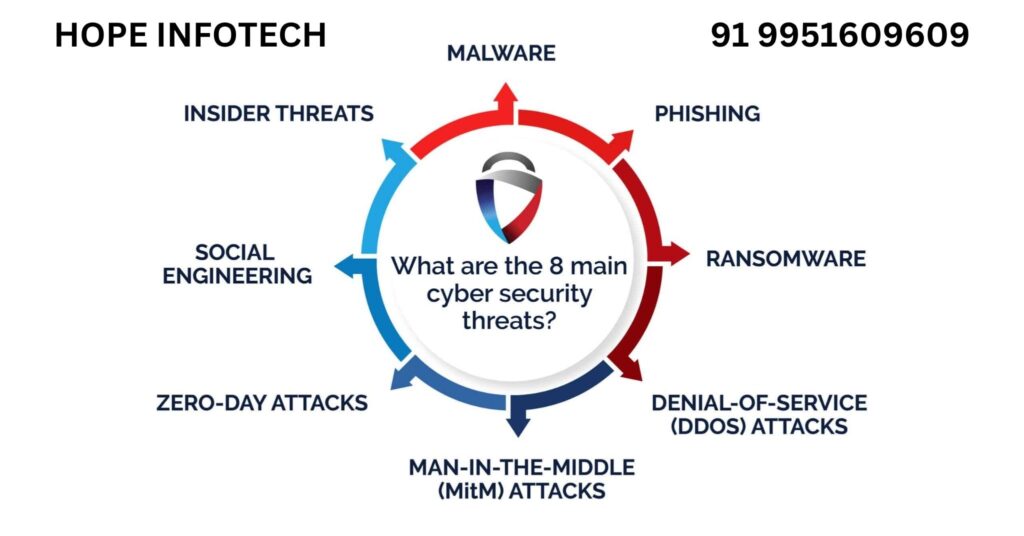
1. Malware
Malwarwhich usually stands for harmful software, encompasses ransomware, trojans, worms, viruses, and spyware.These programs break into systems in order to obtain unauthorized access, interfere with operations, or steal data.
2. Phishing Attacks
Phishing is the practice of sending misleading emails or messages with the intention of fooling recipients into disclosing private information, including credit card numbers and passwords.
3. Ransomware
The victim’s data is encrypted by this kind of virus, which then demands a ransom to unlock it. One of the most costly cyberthreats nowadays is ransomware.
4. Denial of Service (DoS) Attacks
Distributed Denial of Service (DDoS) attacks flood a system with traffic, crippling it and rendering it inoperable for users.
5. Insider Threats
These happen when partners, contractors, or staff members purposefully or inadvertently jeopardize security from within a company.
6. Zero-Day Exploits
Before developers have a chance to patch a vulnerability, these attacks take place the same day it is found.
Best Online Software Training Institute in Hyderabad
5. Core Components of Cybersecurity
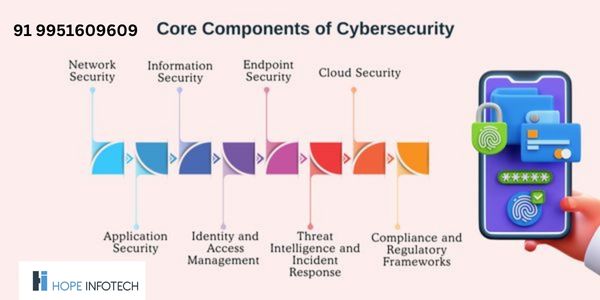
1. Security of Networks
This secures hardware like switches, routers, and firewalls to prevent intrusions into internal networks. Virtual private networks (VPNs) and intrusion detection systems (IDS) are examples of techniques.
2. Security of Applications
protecting apps and software from flaws both before and after creation. This covers access control, patch management, and code analysis.
3. Security of Endpoints
All networkconnected devices, including desktops, laptops, and mobile phones, require protection via device management, encryption, and antivirus software.
4. Cloud Protection
To secure data hosted on platforms such as AWS, Azure, or Google Cloud, cloud security comprises identity and access management (IAM), data encryption, and compliance solutions.
5. Security of Information (InfoSec)
Protecting data availability, confidentiality, and integrity while it is being processed, stored, or in transit is the main goal of information security.
6. Security of Operations (OpSec)
This includes choices and activities pertaining to resource protection and data handling, including guidelines for data sharing and user permissions.
6. Best Practices for Cybersecurity Implementation
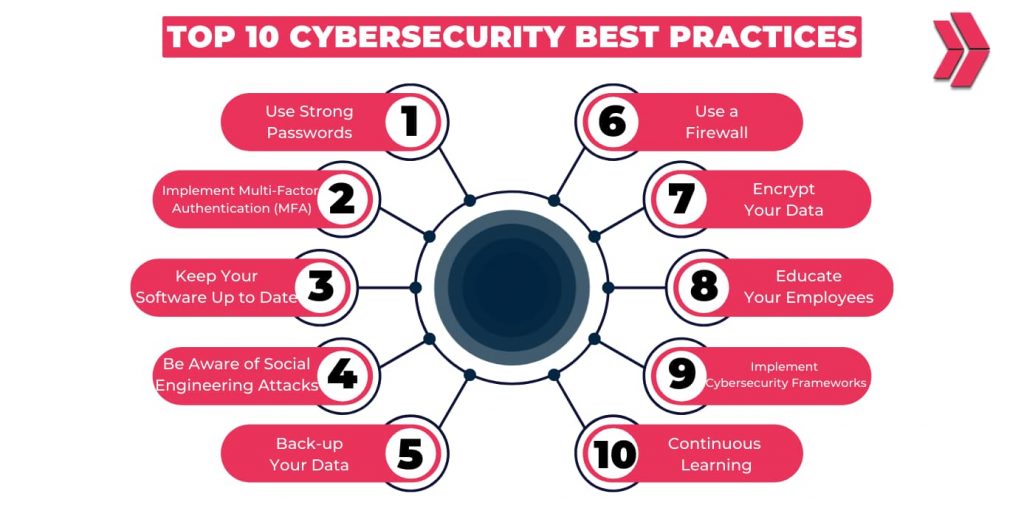
1. Regular Software Updates and Patch Management
Regular software updates reduce exploitable vulnerabilities and help seal security flaws.
2. Multi-Factor Authentication (MFA)
By requiring two or more verification steps for user identification, MFA adds an additional degree of security.
3. Employee Training and Awareness
Human mistake continues to be one of the most significant risks. It is essential to teach staff members how to spot phishing emails, create secure passwords, and use the internet safely.
4. Data Backups
Regular encrypted data backups guarantee that you can retrieve data in the event of ransomware attacks or other cyber catastrophes.
5. Incident Response Planning
In order to respond quickly and effectively in the case of a breach, a proactive strategy entails creating a cyber incident response plan.
7. Cybersecurity in Different Sectors
1. Cybersecurity in Banking and Finance
Targets with high value include financial institutions. They use multi-layered security, which includes AI-driven fraud detection systems, biometric authentication, and transaction monitoring.
2. Healthcare Cybersecurity
Healthcare is at risk from IoT medical equipment and Electronic Health Records (EHRs). Data encryption and HIPAA compliance are crucial for safeguarding patient privacy.
3. Defense and Government
Nation-state actors are a continual threat to government agencies. They depend on task groups, air-gapped systems, and advanced encryption.
4. The Education Sector
Large volumes of teacher and student data are stored by universities. Secure access controls and network segmentation are necessary for in education.
5. Ecommerce and Retail: Retailers manage personal client
information and financial data. Web application firewalls, secure payment gateways, and PCI DSS compliance are important security measures.
8. Emerging Trends in Cybersecurity

1. Machine learning and artificial intelligence
AI is changing cybersecurity through real-time threat detection, behavioral analytics, and automated incident response.
2. Architecture of Zero Trust
This method necessitates constant verification and stringent access controls since it implies that no user or system is trusted by default.
3. Cryptography using quantum mechanics
As quantum computing improves, quantum-safe encryption is being developed to defend data against exponentially quicker attacks.
4. Mesh Architecture for Cybersecurity (CSMA)
By deploying interoperable security technologies across many contexts, CSMA helps enterprises increase threat visibility and scalability.
9. Cybersecurity Career Pathways
Cybersecurity offers high-demand, lucrative career opportunities across sectors.
- Security Analyst – Monitors systems and investigates incidents.
- Penetration Tester (Ethical Hacker) – Simulates attacks to find vulnerabilities.
- Security Engineer – Builds and maintains secure systems.
- Chief Information Security Officer (CISO) – Oversees the entire cybersecurity framework.
Certifications such as CompTIA Security+, CEH, CISSP, and CISM enhance professional credibility and opportunitie
10. Top Tools and Technologies in Cybersecurity
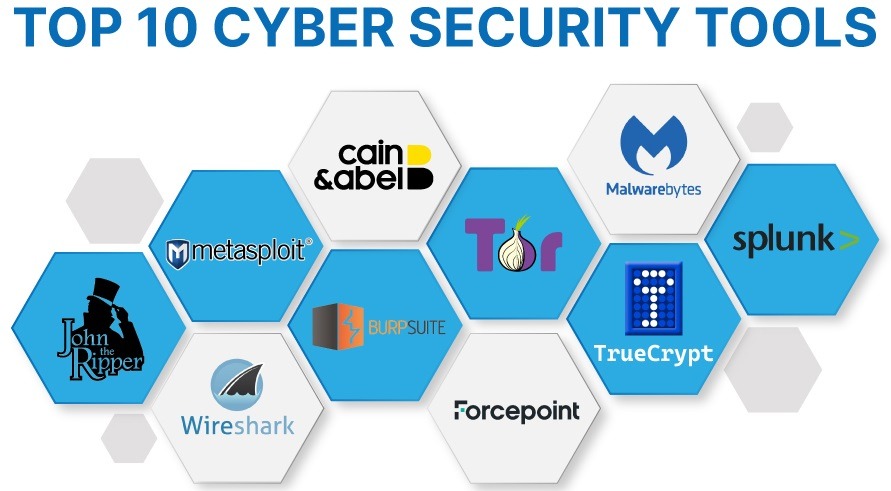
SIEM (Security Information and Event Management): Splunk, IBM QRadar
Antivirus and Anti-malware: Norton, Bitdefender
Firewalls: Palo Alto, Fortinet
Vulnerability Scanners: Nessus, OpenVAS
Encryption Tools: VeraCrypt, AxCrypt
Password Managers: LastPass, 1Password
11. Cybersecurity Regulations and Compliance
Global and national laws enforce data privacy and cybersecurity compliance, including:
- GDPR (EU) – Protects EU citizen data.
- HIPAA (USA) – Safeguards health information.
- ISO/IEC 27001 – International standard for information security management systems.
- NIST Framework (USA) – Guidelines for improving critical infrastructure cybersecurity.
12. Final Thoughts: Building a Cyber-Resilient Future
As cyber threats continue to grow in sophistication, adopting a proactive, layered, and adaptive approach to cybersecurity is no longer an option—it’s a necessity. Organizations and individuals alike must remain vigilant, informed, and ready to respond. Investing in the right tools, strategies, and training is the cornerstone of long-term digital resilience.
FAQs
1. What is cybersecurity?
Cybersecurity refers to the practice of protecting systems, networks, and programs from digital attacks. It involves safeguarding data, software, and hardware against theft, damage, or unauthorized access.
2. Why is cybersecurity important?
Cybersecurity is essential to prevent data breaches, identity theft, financial loss, and system disruptions. With the increasing reliance on technology, strong measures ensure business continuity, data privacy, and public trust.
3. Who needs cybersecurity?
Everyone—from individual users to large organizations—needs . Sectors like healthcare, finance, education, and government are particularly vulnerable and must implement robust security strategies.
4. What are common types of cyberattacks?
Some of the most common cyberattacks include:
- Phishing
- Ransomware
- Malware
- Man-in-the-Middle (MITM) attacks
- Denial of Service (DoS/DDoS)
- Insider threats
- SQL injection
5. How can I protect my personal data online?
- Use strong, unique passwords
- Enable multi-factor authentication
- Avoid clicking on suspicious links
- Keep software and devices updated
- Use antivirus and firewalls
- Avoid using public Wi-Fi without a VPN
6. What is multi-factor authentication (MFA)?
MFA adds an extra layer of security by requiring users to provide two or more verification methods—such as a password plus a fingerprint or one-time code—before gaining access.
7. What is the difference between cybersecurity and information security?
Cybersecurity focuses on protecting digital assets and systems, while information security encompasses all forms of data protection—digital or physical.
8. What are some key cybersecurity certifications?
Popular certifications include:
- CompTIA Security+
- Certified Ethical Hacker (CEH)
- Certified Information Systems Security Professional (CISSP)
- Certified Information Security Manager (CISM)
9. How do companies handle cyber incidents?
Organizations typically have an Incident Response Plan (IRP) in place. This includes identifying, containing, eradicating, recovering, and learning from a cyber incident.
10. Is cybersecurity a good career?
Yes, cybersecurity is a fast-growing field with high demand, attractive salaries, and opportunities across industries. It offers diverse roles like security analyst, penetration tester, and security architect.